REVIEW · KUALA LUMPUR
Historical Malacca Day Tour with Lunch from Kuala Lumpur
Book on Viator →Operated by SKYTRIPS TRANSPORT · Bookable on Viator
Red Square to riverfront in one day. This Malacca day trip strings together Portuguese, Dutch, and British-era sights in a tight route, with hotel pickup doing the heavy lifting and Baba Nyonya lunch keeping you fueled between stops. One practical thing to plan for: this tour includes lunch, but other meals are not.
I like the simple setup: an English-speaking driver handles the logistics in an air-conditioned vehicle, and you get a smooth flow through major landmarks across different religions and communities. Expect a packed schedule, though—most stops are around 30 minutes, so you’ll want to move with purpose.
In This Review
- Quick highlights
- Entering Malacca from Kuala Lumpur: what the day feels like
- St. Peter’s Church: oldest Catholic roots in action
- Stadthuys and the Red Square zone: power center in red walls
- The Melaka River walk: Portuguese and Dutch tension, told in footpaths
- Jonker Street: your hour to eat, browse, and slow down
- Sri Poyatha Vinoyagar Moorthi Temple: Hindu heritage with old roots
- Cheng Hoon Teng Temple: a rare three-tradition Chinese temple
- Kampung Kling Mosque: Harmony Street’s spiritual neighbor
- A Famosa Fort: Portuguese walls and surviving European bones
- Masjid Selat Melaka: a mosque that looks like it’s floating
- Maritime Museum (Muzium Samudera): what you pay and why it can be optional
- The free Nyonya cooking stop: Peranakan flavor of the day
- Price and value: does $138.63 make sense?
- Timing reality check: fast stops, smart pacing
- Comfort and practical tips (the stuff that matters)
- Who should book this Malacca day tour
- Should you book this Malacca day tour?
- FAQ
- How long is the Kuala Lumpur to Malacca day tour?
- Does the tour include hotel pickup and drop-off in Kuala Lumpur?
- Is lunch included, or are all meals provided?
- Are admission tickets included for all stops?
- What kind of transportation do you use?
- How many stops are there and what’s the visit time like?
- What’s the group size limit?
- Is the tour wheelchair accessible?
Quick highlights
- Pickup and drop-off from your Kuala Lumpur hotel so you start and end without a headache
- A small max-group format (up to 15) in a private-feeling day, not a crowded bus crush
- Many admission tickets included for key stops like St. Peter’s Church, Stadthuys, and multiple temples/mosques
- A focused cultural circuit that includes Catholic, Hindu, Chinese/Buddhist/Taoist, and Islamic sites
- Serious photo stops built in: Red Square area, A Famosa, and the waterside Masjid Selat Melaka
- Jonker Street with real time (1 hour) to eat, browse, and reset your brain after museums
Entering Malacca from Kuala Lumpur: what the day feels like
This is an 8-hour outing that starts in Kuala Lumpur and spends the bulk of the time in Malacca City. The drive itself can feel long, but the benefit is clear: you’re not fighting transport changes or timing. Once you arrive, the route becomes a sequence of short, meaningful stops—churches, forts, temples, mosques, and then shopping and snacks.
The big value here is the combination of included lunch, bottled water, and an A/C vehicle. When you’re moving between sites with sun and heat, comfort matters more than you think. Also, the tour is designed for many ages, and it’s not a marathon—just a full day packed with stops.
One note that shapes your expectations: you’re not just drifting through Malacca at leisure. You’ll likely spend more time transitioning than you would on a self-guided day. If you like to linger, keep your phone charged and your camera ready, but don’t plan on deep, slow exploration at every site.
You can also read our reviews of more historical tours in Kuala Lumpur

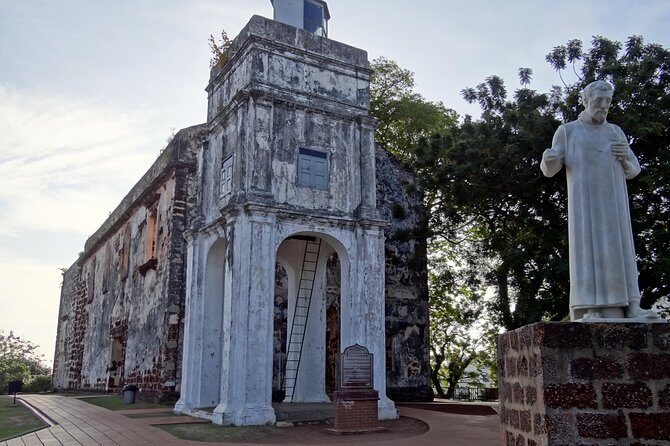
St. Peter’s Church: oldest Catholic roots in action
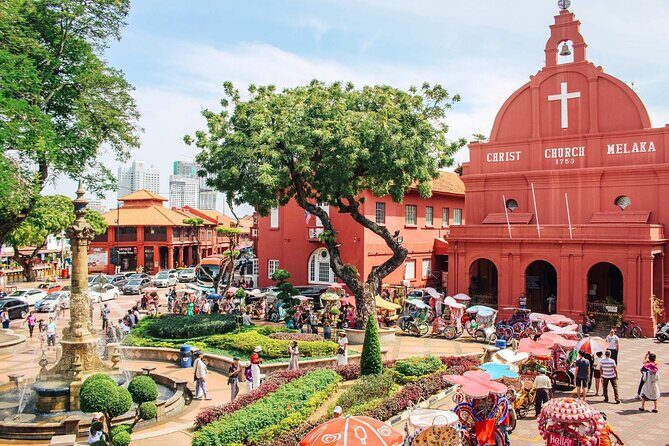
Your first stop is St. Peter’s Church, listed as the oldest functioning Roman Catholic church in Malaysia. You get about 30 minutes, with the admission ticket included.
Why this stop matters: Malacca isn’t only about ruins and old stones. It’s a living crossroads, and early Catholic presence is part of that story. Take this as your warm-up before the rest of the Portuguese and Dutch influence you’ll see shortly.
Practical tip: use your first 30 minutes to get oriented. This is where I’d start building a mental map—then the rest of the day clicks faster because you’re connecting buildings to the wider Red Square and river area.
Stadthuys and the Red Square zone: power center in red walls
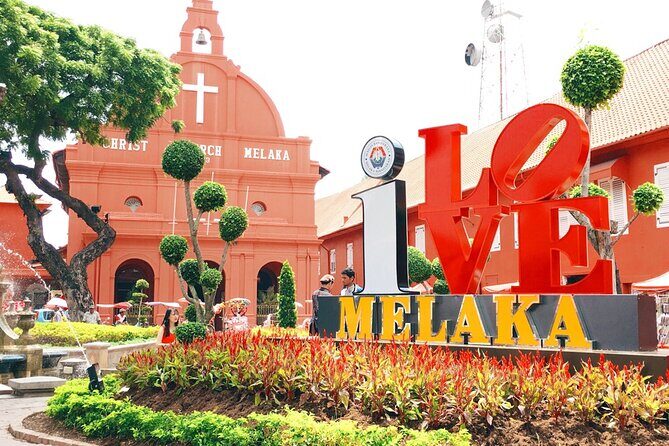
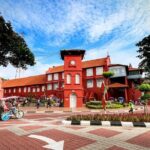
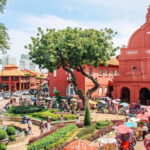
Next up is Stadthuys, a prominent historical building in the heart of Malacca City, around the Red Square area. You get 30 minutes, with the admission ticket included.
Think of Stadthuys as a visual anchor. The red exterior is a clue that this was an administrative center, and Malacca’s colonial layers show up everywhere you look. Even if you only absorb the outside details, you’re in the right geographic pocket for the rest of today’s story.
What to watch for in your time here:
- How the building frames the square and helps you “place” the rest of the route
- Signs of colonial-era design blended into local street life
- Any open viewing areas connected to the museum-style experience
The Melaka River walk: Portuguese and Dutch tension, told in footpaths
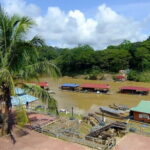
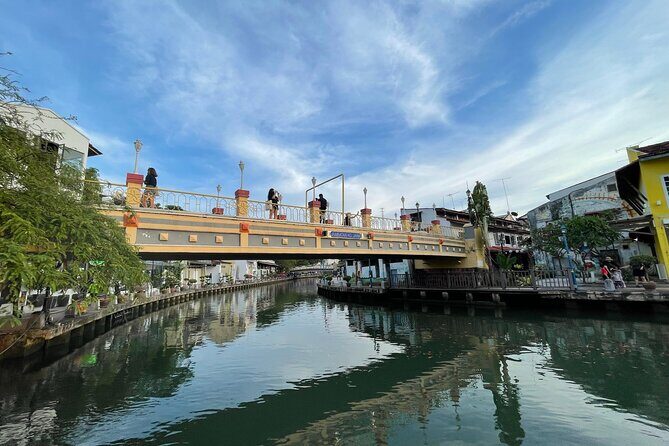
Then it’s time for the River Walk (also about 30 minutes with admission ticket included). The Melaka River winds through the city near Dutch Square and past the Tan Boon Seng Bridge. The route ties directly to conflict history—the Portuguese seized the bridge during the Portuguese invasion and disrupted communications between sides.
Even if you’re not a history person, river areas help you understand why Malacca became such a magnet for trade. Water routes meant wealth, power, and rivalry.
A practical way to use this stop: treat it like a reset. You’ll have done churches and buildings. Here you can step away from walls, see the river’s layout, and then head into the street market phase with less fatigue.
Jonker Street: your hour to eat, browse, and slow down

Jonker Street is next, with 1 hour and admission ticket included (the ticket note here usually applies to certain attractions/events rather than the entire street). This is the Malacca place people actually plan their day around—street life, small shops, and food stops.
I love this block because it’s where history turns human. You’re not only looking at old architecture; you’re seeing how the city lives now. If you arrive at Jonker Street with energy, you can actually enjoy the mix of browsing and sampling rather than just sprinting through.
How I’d use your hour:
- Walk one end to the other once, then decide what to revisit
- Keep your group’s timing in mind; 1 hour disappears fast here
- If you’re aiming for snacks, don’t wait until the end of the hour to hunt
A few more Kuala Lumpur tours and experiences worth a look


Sri Poyatha Vinoyagar Moorthi Temple: Hindu heritage with old roots
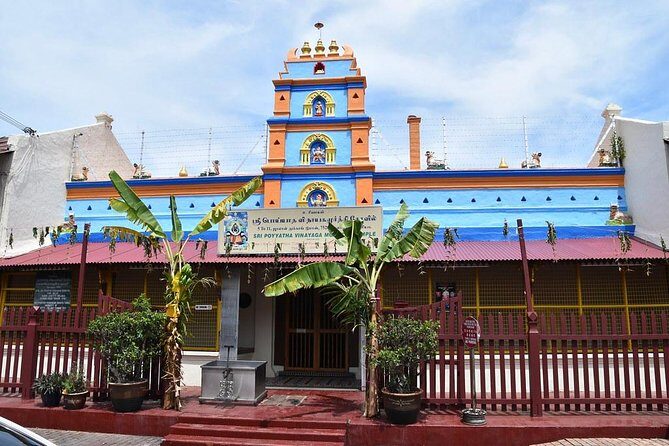
At Sri Pogyatha Vinoyagar Moorthi Temple, you’ll get 30 minutes with admission ticket included. This is described as the oldest Hindu temple in Malaysia and among the oldest functioning Hindu temples in Maritime Southeast Asia.
This stop is valuable because it broadens Malacca’s story beyond the European colonial thread. Malacca’s identity is not one culture—it’s a layered port city where communities have lived side by side.
What I’d focus on:
- Architectural and spiritual cues that show how the site has functioned over time
- The way this temple sits within the modern city rhythm you’ve been walking through
Cheng Hoon Teng Temple: a rare three-tradition Chinese temple
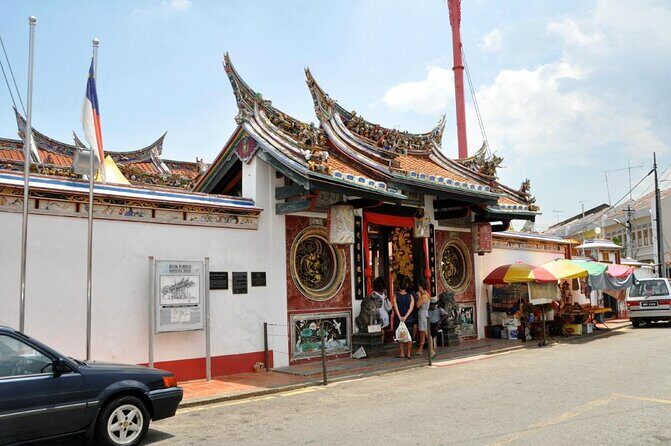
Next is Cheng Hoon Teng Temple (about 30 minutes, admission ticket included). It practices the three doctrinal systems of Buddhism, Confucianism, and Taoism, and it’s described as the oldest functioning Chinese temple in Malacca.
This is one of those stops where the details can matter. Even if you don’t read every plaque, notice the mix of influences and how religious practice is organized in one place.
If you want to get more out of the time, ask your driver/guide one simple question: what are the key features you’re supposed to notice here? Some guides can turn a 30-minute stop into a memory you keep for years.
Kampung Kling Mosque: Harmony Street’s spiritual neighbor
Then you’ll visit Kampung Kling Mosque, about 30 minutes with admission ticket included. It’s an old mosque in Malacca City, on a street also called Harmony Street, because of its proximity to Sri Poyatha Vinoyagar Moorthi Temple.
That name—Harmony Street—isn’t just cute. It’s a reminder that this city formed through close neighbors, not isolated zones. This stop helps you see religious coexistence in a very practical way: temples and mosques are part of the same walkable city fabric.
If you like photography, use your first 5 minutes to scout angles before people flow in and out.
A Famosa Fort: Portuguese walls and surviving European bones
Your next big time block is A Famosa Fort with about 1 hour and admission ticket included. A Famosa was a former Portuguese fortress, noted as one of the oldest surviving European architectural remains in Southeast Asia and the Far East. The Porta de Santiago is the small gate house highlight mentioned in the tour details.
This is a major “wow” stop because forts are built for sightlines. You can read the shape of power in the geometry, even if only parts remain.
Spend the hour like this:
- First, walk it once for overall structure
- Then, slow down for the details near the gate area
- Use the final minutes to get exterior photos that show scale
Masjid Selat Melaka: a mosque that looks like it’s floating
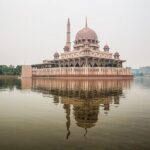
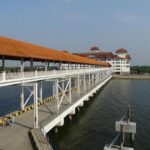
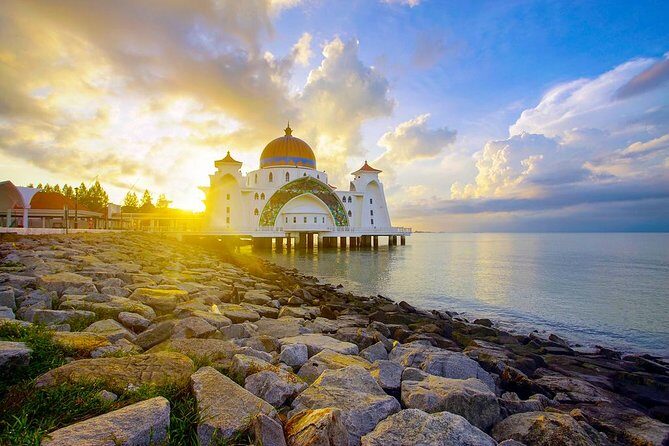
Next: Masjid Selat Melaka for about 1 hour with admission ticket included. The description emphasizes that it’s built using a mix of Middle Eastern and Malay craftsmanship and can look like a floating structure when water levels are high.
Even if you don’t catch the exact water-level effect, it’s still a compelling visual—architecture on water tends to pull your attention right away. This stop works well as a change of pace from forts and museums.
A good strategy: after walking A Famosa, this is the moment to reset your eyes. Then you’ll be ready for the next indoor space.
Maritime Museum (Muzium Samudera): what you pay and why it can be optional
After the mosques, you’ll go to Muzium Samudera (Maritime Museum) for about 30 minutes. The tour details explicitly say the admission ticket is not included.
This is the one stop on the route where your wallet matters. The museum is described as the most visited museum in Malacca, with monthly visitors around 20,000—so there’s likely enough there to justify the cost if maritime trade is your interest.
Should you skip it? If you’re not into museum time, you might prefer to spend that energy on Jonker Street walking. But if you want the port-city context behind everything else you’ve seen, this is the natural place to learn it.
The free Nyonya cooking stop: Peranakan flavor of the day
Your final included stop is labeled Melaka, with a 1-hour time block and admission ticket free. It connects to Nyonya cooking—the Peranakan blend of Chinese ingredients with Malay/Indonesian spices and techniques.
Even when you’re not taking a class, this kind of stop gives you a cultural bridge. By now you’ve seen multiple communities in place. Cooking ties those communities together in a way that’s easy to understand and take home with you through flavor.
If there’s any tasting or practical demo component during your visit (you might see cooking demonstrations rather than a standard museum), it’s the kind of stop that helps your brain connect the day beyond photos.
Price and value: does $138.63 make sense?
At $138.63 per person for an approximately 8-hour day trip, this can be good value if you care about two things: (1) not coordinating transport yourself and (2) getting into key sights without additional planning.
Here’s what you’re paying for in practical terms:
- A/C vehicle and hotel pickup and drop-off, which removes the hardest part of a KL-to-Malacca day
- Lunch: Baba Nyonya food is included
- Bottled water
- Admission tickets are listed as included for many major stops (though you should double-check what’s covered for each attraction in your exact voucher, since the Maritime Museum ticket is explicitly not included)
The main reason this price works for some people: it buys time. A DIY day means you’d spend extra effort figuring out routes, ticket timing, and where you’ll eat. Here, the day is structured.
The main reason it might not be a fit for others: with lots of stops that are 30 minutes, you don’t get long, slow museum time. If your ideal day is unhurried, consider whether you want a driver-based route or a full-on walking day with fewer stops.
Timing reality check: fast stops, smart pacing
This itinerary is built around short visits. Several stops are 30 minutes, while Jonker Street, A Famosa, Masjid Selat Melaka, and the Nyonya cooking stop are longer blocks.
So you should treat the day like a checklist with breathing space. If you arrive hungry for deep reading, you’ll feel rushed. If you arrive ready to look, listen when you can, and ask quick questions, you’ll do great.
One more pacing thought: if you go on a day when certain buildings are closed, you may still enjoy the exterior viewpoints and street-level atmosphere. That’s not a failure—it’s how you keep the day enjoyable even if interiors are limited.
Comfort and practical tips (the stuff that matters)
A few practical points shape the experience more than people expect:
- The tour is not wheelchair accessible, so plan accordingly if mobility is an issue.
- Lunch is included, but other meals aren’t. If you’re prone to getting hungry, treat breakfast before pickup and keep some light snacks in your day bag for gaps.
- Many stops include admission tickets, but Maritime Museum admission is not included, so bring cash or a card for that option.
- The tour has a maximum of 15 travelers, which usually means shorter group herding and easier movement than big bus tours.
If you want to maximize value, come prepared with one or two questions you care about—like which colonial influence you’re seeing most today, or what makes Cheng Hoon Teng unique. That way your 30 minutes become yours, not just time spent walking.
Also, if you get a guide who can explain the connection between Portuguese bridges, Dutch squares, and the way the city grew, you’ll feel like the stops link together instead of standing alone. In past experiences, a guide named Mr Shah has been described as especially knowledgeable, which is the best-case scenario for making this route feel more than just transportation.
Who should book this Malacca day tour
This tour is a great match if you:
- Want a structured, low-effort day from Kuala Lumpur
- Like seeing many cultural sites in one circuit (not just forts or museums)
- Prefer included lunch and simple logistics over planning your own route
- Don’t mind short time at each stop and you’re happy to choose where to spend extra attention
It’s less ideal if you:
- Want long, slow museum time at every venue
- Prefer full control to linger wherever you like most
- Need step-free access (since it’s not wheelchair accessible)
Should you book this Malacca day tour?
I’d book it if your goal is a one-day snapshot of Malacca that hits the major landmarks without you doing the heavy planning. The combination of hotel pickup, A/C comfort, included Baba Nyonya lunch, and multiple admission-included stops makes it a strong value for a packed day.
I’d skip or modify if you’re the type who hates rushing between places. In that case, you might get more satisfaction by building a slower Malacca day on your own (or pairing this tour with extra time on Jonker Street before or after).
If you want variety—Catholic history, Hindu and Chinese temple heritage, Islamic architecture, plus Portuguese fort remains—this route delivers exactly that in a single exhausting but rewarding day.
FAQ
How long is the Kuala Lumpur to Malacca day tour?
The tour duration is approximately 8 hours.
Does the tour include hotel pickup and drop-off in Kuala Lumpur?
Yes, hotel pickup and drop-off are included.
Is lunch included, or are all meals provided?
Lunch is included (Baba Nyonya food). The tour notes that meals are not included, meaning you should plan for meals other than lunch.
Are admission tickets included for all stops?
Many stops list admission tickets as included, but the Maritime Museum ticket (Muzium Samudera) is specifically not included. Check your exact inclusions before you go.
What kind of transportation do you use?
You travel in an air-conditioned vehicle, and bottled water is provided.
How many stops are there and what’s the visit time like?
There are multiple stops across Malacca City, with many visits around 30 minutes, plus longer blocks for places like Jonker Street and A Famosa.
What’s the group size limit?
The tour has a maximum of 15 travelers.
Is the tour wheelchair accessible?
No, the tour is not wheelchair accessible.